Buyer Guide · Import & Export · 20 min read
Importing ceramics
from India.
A first ceramic import is rarely difficult, but it is unforgiving of small mistakes. The wrong product code, the wrong delivery terms on a container, or a missing safety document can hold a shipment at the border for longer than it took to make the goods.
Most ceramic imports follow broadly the same sequence, and this guide follows it too: decide how the goods are classified and who is responsible for what, check whether your market’s food-safety rules apply, sample and inspect the production, agree the packing, book the freight, collect the documents, and clear customs at your end. No prior export experience is assumed. Terms are explained the first time they appear.
Everything up to the last section is general guidance that applies to any Indian ceramic supplier, not just to us. Where a rule has a source, we name it so you can check the current text yourself. Regulations and duty rates change, so treat specific figures here as a starting point for your own verification rather than as advice.
Last reviewed: August 2026
Published 3 August 2026 · Last reviewed 23 August 2026
Who This Is For
Written for the first shipment.
- Importers buying from India for the first time
- Wholesalers and distributors moving into direct sourcing
- Retail chains placing their own private-label orders
- Hospitality buyers specifying for hotels, resorts and cafés
- Interior and sourcing agencies buying on a client’s behalf
If you already run regular containers out of India, most of this will be familiar and the sections on food-contact rules and origin marking are the ones worth your time.
The Route
Seven stages, in order.
- Classify & agree terms
- Sample & approve
- Production
- Inspection
- Packing & marking
- Freight
- Customs & delivery
Before You Order
Three decisions that shape everything else.
Most import problems trace back to one of three things being settled late or not at all. Settle them before you place the order and the rest of the process is mostly paperwork.
How the goods are classified. Every product crossing a border is given a numeric code that customs authorities use to identify it. That code sets your duty rate and also decides which product rules apply. Get it wrong and you either overpay for years or face a correction with penalties.
Where responsibility changes hands. The delivery terms, known as Incoterms, are a set of standard three-letter codes that say who arranges the transport, who insures the goods, who deals with customs at each end, and the exact point at which the risk of breakage stops being the seller’s problem and starts being yours. On fragile cargo that last point matters more than it does on most goods.
Whether the pieces touch food. This is a genuine fork in the road. Food-contact ceramics carry testing and documentation obligations in most developed markets. Purely decorative ceramics carry almost none. Buyers routinely apply the wrong set of rules to the wrong half of their order.
Step One
Getting the HS code right.
The classification system is called the Harmonised System, usually shortened to HS. It is a numbered catalogue of every kind of traded good, maintained internationally and used by customs authorities almost everywhere. The first six digits of a code mean the same thing in every country; your own country then adds further digits for its own duty rates. A four-digit group is called a heading.
Ceramic goods sit in Chapter 69, and four headings cover almost everything in a home décor shipment.
| Heading | What it covers | Example |
|---|---|---|
| 6911 | Tableware, kitchenware, other household and toilet articles, of porcelain or china | A porcelain cup and saucer |
| 6912 | The same articles in ceramic other than porcelain or china, which includes stoneware and earthenware | A stoneware cup and saucer, or a stoneware soap dish and dispenser |
| 6913 | Statuettes and other ornamental ceramic articles | A figurine, or a vase bought as an ornament rather than as kitchenware |
| 6914 | Other ceramic articles not covered above | The residual heading, used when nothing else fits |
Two practical notes. First, the porcelain and stoneware split is a material question, not a quality one, and it is worth asking your supplier what the body actually is rather than assuming. Our own range is stoneware, which puts the functional pieces in 6912 rather than 6911.
Second, the functional versus ornamental line is where classification arguments happen. A vase is generally ornamental. A storage jar you sell as kitchenware generally is not. If a product sits genuinely on the boundary and the volumes justify it, you can ask customs to decide in advance and commit to the answer in writing, which protects you from a later reassessment. In the United States this is called a CBP ruling; in the EU it is Binding Tariff Information.
One thing worth knowing about the Harmonised System notes for headings 6911 to 6913: an “article” can be more than one physical piece. A pot and its lid, imported together, count as a single article. That matters when you are declaring a three-piece bathroom set or a cup with its saucer.
Step Two
Incoterms, and the container trap.
Incoterms 2020, published by the International Chamber of Commerce, sets out eleven of these three-letter codes. Seven work for any kind of transport, including road, air and sea. Four were written specifically for sea and inland waterway shipping, and it is those four that catch people out.
The four sea-only rules are FAS (Free Alongside Ship), FOB (Free On Board), CFR (Cost and Freight) and CIF (Cost, Insurance and Freight). The seven that work for any transport include EXW (Ex Works), FCA (Free Carrier), CIP (Carriage and Insurance Paid To) and DDP (Delivered Duty Paid).
The table below shows what the seller is obliged to do under each of the terms you are most likely to be quoted, and where the risk passes to you. Read the last column carefully. Under CIF and CIP the seller pays for carriage to a point well past where the risk has already become yours, which is the single most misread thing about the rules.
| Term | Export clearance | Main freight | Insurance | Import duty | Delivery to your door | Risk passes |
|---|---|---|---|---|---|---|
| EXWEx Works | ○Buyer pays Export clearance | ○Buyer pays Main freight | ○Buyer pays Insurance | ○Buyer pays Import duty | ○Buyer pays Delivery to your door | At the seller’s premises |
| FCAFree Carrier | ●Seller pays Export clearance | ○Buyer pays Main freight | ○Buyer pays Insurance | ○Buyer pays Import duty | ○Buyer pays Delivery to your door | On handover to your carrier |
| FOBFree On Board | ●Seller pays Export clearance | ○Buyer pays Main freight | ○Buyer pays Insurance | ○Buyer pays Import duty | ○Buyer pays Delivery to your door | Once on board the ship |
| CIFCost, Insurance and Freight | ●Seller pays Export clearance | ●Seller pays Main freight | ●Seller pays Insurance | ○Buyer pays Import duty | ○Buyer pays Delivery to your door | Once on board the ship |
| CIPCarriage and Insurance Paid | ●Seller pays Export clearance | ●Seller pays Main freight | ●Seller pays Insurance | ○Buyer pays Import duty | ○Buyer pays Delivery to your door | On handover to the first carrier |
| DAPDelivered At Place | ●Seller pays Export clearance | ●Seller pays Main freight | ○Buyer pays Insurance | ○Buyer pays Import duty | ●Seller pays Delivery to your door | At the named destination |
| DDPDelivered Duty Paid | ●Seller pays Export clearance | ●Seller pays Main freight | ○Buyer pays Insurance | ●Seller pays Import duty | ●Seller pays Delivery to your door | At the named destination |
● seller’s obligation. ○ yours. Insurance under CIF is only the narrow Clause C cover described below; under CIP it is the broad Clause A.
FOB is the term everyone has heard of, and it passes risk to the buyer when the goods are on board the ship. That made sense when cargo was loaded loose, piece by piece, over the ship’s side. With a container it does not. The goods are handed over to the shipping line at an inland depot or port terminal, often several days before the container is actually loaded onto a vessel. FOB leaves that whole gap in an awkward place: the seller has physically given the goods away but is still carrying the risk if anything happens to them.
For anything shipping in a container, the ICC’s own guidance is to use FCA instead. FCA transfers the risk cleanly at the point where the goods change hands, wherever you agree that is. If you are asking for a quote on a full or part container of ceramics, ask for FCA rather than FOB.
Use for containers
FCA
- Works for any transport, including containers and air
- Risk passes when the goods are handed over, which is when you can actually insure them
- No gap between losing the goods and losing the risk
- The ICC’s own recommendation for containerised cargo
Older, sea only
FOB
- One of four rules written for sea and inland waterway only
- Risk passes only once the goods are on board the vessel
- Leaves days of terminal handling where the seller holds risk over goods they no longer have
- Still the right choice for loose bulk cargo loaded directly onto a ship
Insurance is the other detail worth knowing, because two similar-looking terms buy very different cover. Marine cargo policies come in standard grades called Institute Cargo Clauses. Clause A is broad, close to all-risks. Clause C is much narrower and only pays out for a short list of named events such as fire, sinking or collision. Ordinary breakage is not on that list.
Under Incoterms 2020, CIF only obliges the seller to buy Clause C. CIP obliges them to buy Clause A. This was a deliberate change from the 2010 version, where both sat at Clause C, made because CIP is more often used for manufactured goods.
For a first order, the two extremes are worth thinking about carefully. EXW means the goods are yours from the seller’s factory door, so you handle everything including export clearance in a country whose paperwork you do not know. DDP means the seller handles everything including the import duty at your end, which sounds convenient until you realise you need the customs entry to be in your own name for your accounts and your duty records.
Step Three
Food-contact rules, and what they do not cover.
Ceramic food-contact regulation exists because lead and cadmium were historically used in glazes, and small amounts can pass out of the glaze into the food or drink held in the piece. This is called migration, and it happens fastest with acidic contents such as fruit juice, vinegar or tomato. The rules apply only to articles intended to come into contact with food. They do not apply to a vase, a figurine, a wall piece or a bathroom accessory, because none of those hold food.
This split runs straight through a typical décor consignment. In our own range, the cup and saucer sets are food-contact and the bathroom sets are not, even though both are washed ware. Storage jars depend on what you tell your customer they are for.
United States
The FDA sets what it calls action levels for lead in ceramicware in Compliance Policy Guide 545.450, with a parallel guide covering cadmium. An action level is the point at which the agency may act against a product. It is an enforcement trigger rather than a line between safe and unsafe, so meeting it means low-lead rather than lead-free.
The test is straightforward in principle. The piece is filled with a weak vinegar solution, 4 percent acetic acid, left to stand, and the liquid is then measured for how much lead came out of the glaze. Results are given in parts per million, written ppm. The limits are tightest for the pieces you drink from directly.
Two FDA terms are worth translating. Flatware means shallow pieces such as plates and saucers. Hollowware means deeper vessels such as bowls, jars and jugs, split into small and large by whether they hold less or more than 1.1 litres.
| Article category | Lead action level |
|---|---|
| Flatware, internal depth under 25 mm | 3.0 ppm |
| Small hollowware other than cups and mugs, depth over 25 mm and capacity under 1.1 L | 2.0 ppm |
| Large hollowware other than pitchers, depth over 25 mm and capacity 1.1 L or more | 1.0 ppm |
| Cups and mugs | 0.5 ppm |
| Pitchers | 0.5 ppm |
European Union
The EU works from Council Directive 84/500/EEC, as amended by Commission Directive 2005/31/EC, sitting under the general food-contact framework of Regulation 1935/2004. Articles fall into three categories by shape and capacity, and each category has its own lead and cadmium limit.
Watch the units, because they change between categories. Shallow pieces are measured by surface area, in milligrams per square decimetre (mg/dm²), because there is no sensible volume to measure. Pieces you can fill are measured by volume, in milligrams per litre (mg/l).
| Category | Lead | Cadmium |
|---|---|---|
| Category 1: articles that cannot be filled, and fillable articles with an internal depth of 25 mm or less | 0.8 mg/dm² | 0.07 mg/dm² |
| Category 2: all other fillable articles | 4.0 mg/l | 0.3 mg/l |
| Category 3: cooking ware, and packaging or storage vessels over 3 litres | 1.5 mg/l | 0.1 mg/l |
Alongside the limits sits a paperwork obligation that catches people out. Food-contact ceramics must travel with a written declaration of compliance, a signed statement from the maker confirming the pieces meet these limits. It is required at every stage of selling except the final sale to a consumer, which means you as the importer must be able to produce it on request. Ask for it with the shipping documents, not after a customs query.
Do not stop at the EU-wide text, because individual member states can and do go further. The Netherlands amended its Commodities Act with effect from 29 May 2026 and cut the permitted amounts sharply. For ordinary fillable pieces the lead limit there becomes 30 micrograms per litre, against 4.0 milligrams per litre in the Directive, which is more than a hundred times stricter. Stock that met the old limits and reached the market by 1 December 2026 can be sold through. The lesson generalises: check the rules of the specific country you are shipping to rather than assuming the EU-wide figure is the ceiling.
Our materials and safety guide covers what food-safe and lead-free actually mean at the glaze level, which is the other half of this conversation.
During Production
Sampling and inspection.
Approve a physical sample before production starts. Photographs do not tell you the weight of a piece, how true a glaze reads in daylight, or whether a dispenser pump works properly. On hand-finished ceramics a sample also sets the expectation for variation, which matters because some variation is inherent and the point of agreeing a sample is to fix how much is acceptable.
For larger orders, a pre-shipment inspection is the standard control. You hire an independent firm to visit the factory before the goods leave and check a sample of the finished order against what you agreed.
Nobody checks every piece. Inspectors work to a statistical method called AQL, short for Acceptable Quality Limit, set out in the international standard ISO 2859-1, which was reissued in January 2026 replacing the 1999 edition. In plain terms it tells the inspector how many pieces to pull from the batch, and how many faults in that sample mean the whole batch is rejected. You choose an inspection level, where level II is the normal default, and you set a separate AQL figure for serious faults and for cosmetic ones, usually stricter on the serious.
For ceramics specifically, agree in advance what counts as a defect. Pinholes, glaze pooling, slight colour drift between kiln loads and small variations in hand-painted motifs are normal on handmade ware and abnormal on machine-decorated ware. A defect list written for printed porcelain will fail a hand-painted order that is perfectly good.
Packing
Packing, pallets and marking.
Ceramics break in transit for predictable reasons: pieces touching each other, boxes with too little padding around the contents, and pallets stacked higher than the bottom carton can carry. Wrapping each piece individually, adding cardboard dividers or moulded inserts so nothing touches, using an outer box rated to take the crushing weight of the ones above it, and agreeing a maximum stack height covers most of it. Settle carton counts and box dimensions early, because they drive both your freight cost and how your warehouse receives the goods.
If the goods travel on wooden pallets or in wooden crates, an international rule called ISPM 15 applies. It exists to stop insects and tree diseases crossing borders inside untreated timber. Any solid wood packaging thicker than 6 mm must have its bark removed and be treated, most commonly by heating the wood until its core reaches at least 56°C for at least 30 minutes. It must then carry the ISPM 15 stamp on at least two opposite sides.
Country of origin marking is a legal requirement, not a courtesy. In the United States, 19 U.S.C. § 1304 requires every imported article to be marked legibly, indelibly and permanently with the English name of its country of origin, in a conspicuous place, so the ultimate purchaser can see it. The implementing rules note that for earthenware and chinaware the marking is best glazed on during firing. That is a genuine production decision, so raise it with your supplier before the order runs rather than trying to solve it with stickers on arrival.
Shipping
Sharing a container, or filling one.
Sea freight comes in two shapes. LCL, short for less than container load, means your boxes share a container with other people’s cargo and you pay for the space you use, normally per cubic metre. FCL, full container load, means you book a whole container to yourself.
Volume is measured in cubic metres, written CBM in freight quotes. As a rough guide a container holds about 33 CBM if it is a 20 foot box, 67 CBM for a 40 foot, and 76 CBM for a 40 foot high cube, which is simply a taller version of the same thing. You will not actually fit that much in. Boxes do not stack together perfectly and the loaders need room to work, so plan on using somewhere around 85 to 90 percent of those figures. Ceramic décor is bulky rather than heavy for its size, so a container almost always runs out of space long before it reaches its weight limit.
LCL is the sensible choice for a first or trial order. The trade-off is handling. An LCL shipment is packed into a shared container with other cargo at the origin and unpacked again at the destination, and every extra time fragile goods are moved is another chance to break something.
The point where LCL stops paying is usually somewhere around 12 to 15 CBM, where the per-cubic-metre rate plus the handling charges starts to approach the cost of just booking a 20 foot container. Ask for both quotes when your order is near that range. A full container also skips that unpacking step at the far end, which fragile goods would rather avoid.
Air freight is priced on whichever is greater, the actual weight or the space the shipment occupies converted into a weight figure. Ceramics are both heavy and bulky, so they lose on both counts. Air is rarely worth it for anything but samples.
Paperwork
Who produces which document.
Indian export paperwork splits neatly into two kinds: registrations your supplier sets up once and keeps, and documents raised fresh for every shipment. Knowing which is which tells you what is reasonable to ask for, and when to ask for it. A third column covers what falls to you.
Held once, by the exporter
- Importer Exporter Code (IEC): the licence to export at all, issued by India’s trade authority, the DGFT
- AD Code: the exporter’s bank code, registered with customs at every port the goods leave from, so export earnings can be tracked back to a bank account
- GST registration, plus a Letter of Undertaking that lets them export without paying Indian sales tax up front
Raised for every shipment
- Commercial invoice: what was sold, to whom, for how much
- Packing list: what is in each carton, with weights and dimensions
- Shipping bill: the export declaration, filed with Indian customs before loading
- Bill of lading, or air waybill by air: the carrier’s receipt and contract, and the document that releases the goods at the far end
- Certificate of origin, where your country asks for one
Your side, as the importer
- Registration with your own customs authority, which in the EU and UK means an EORI trader number, and in the US a customs bond
- The right HS code for your own country’s tariff
- Any safety paperwork your market requires, such as an EU declaration of compliance for food-contact pieces
- Cargo insurance, unless the delivery terms put it on the seller
A certificate of origin is an official confirmation of where goods were actually made. For Indian exports it is now issued electronically, through the government eCoO platform at trade.gov.in. Electronic filing became mandatory for ordinary certificates from 1 January 2025 and for preferential ones from 17 January 2025.
The two kinds do different jobs. A preferential certificate matters only where a trade agreement between India and your country gives you a reduced duty rate, and it is the document that unlocks that rate. An ordinary, non-preferential certificate simply proves Indian origin, which some countries want for their records regardless of duty.
A useful test of a supplier: ask for their IEC number and which port their AD Code is registered at. Anyone exporting regularly will answer both immediately. Hesitation is not automatically disqualifying, but it tells you they are new to it, and that you will end up managing more of the process than you expected.
At Your Border
Duty, and why this guide will not quote you a rate.
What you pay on arrival depends on four things: the HS code, the value declared to customs, your own country’s standard duty rates for that code, and any special trade measure in force between your country and India on the day the goods arrive. The first three are stable. The fourth is not.
The United States and India illustrate the point. Between mid-2025 and early 2026 the applicable rate on Indian goods moved more than once, through a reciprocal tariff, an additional tariff that was subsequently removed, and a later change of legal basis. Any figure printed in a guide would have been wrong within months.
So the honest advice here is a method rather than a number. Confirm your classification first, then look up the live rate for that code and country of origin in your own customs tariff on the day you cost the order, and leave some room in your landed-cost calculation if the trade relationship is in flux. A customs broker does this as a matter of routine, and for a first import a broker is worth what they charge.
One point that surprises people: duty is charged on the customs value, which is normally the price you paid, with freight and insurance added or excluded according to your own country’s rules. Because the delivery terms decide whether freight and insurance sit inside or outside the invoice price, the Incoterm you agreed changes the amount duty is calculated on. It is not just a question of who books the ship.
Recap
The first-import checklist.
Everything above, condensed to the things that actually have to happen. Work down it in order. Nothing here is specific to any one supplier, so it works as a check on whoever you buy from.
Before you order
- Confirm the HS code for each product line, and request a customs ruling if any sit on a boundary
- Agree the Incoterm in writing, and use FCA rather than FOB for container shipments
- Check whether any pieces are food-contact, and which market’s rules apply
- Confirm who insures the goods in transit, and to what level of cover
During production
- Approve a physical sample, not a photograph
- Agree what counts as a defect, written for the way these goods are actually made
- Book a pre-shipment inspection, and set the AQL for serious and cosmetic faults separately
- Time the inspection with room to remake, not at full packing
Packing and dispatch
- Agree carton counts, box dimensions and a maximum stack height
- Confirm any wooden pallets or crates carry a valid ISPM 15 mark
- Settle country-of-origin marking before the run, since on ceramics it is fired on
- Compare LCL and FCL quotes if the order is near 12 to 15 CBM
Documents and clearance
- Commercial invoice and packing list, checked against the actual shipment
- Bill of lading or air waybill
- Certificate of origin, if your country asks for one
- Declaration of compliance for any food-contact pieces entering the EU
- Look up the live duty rate for your code and origin on the day you cost the order
Our Own Position
Where Home Decoratives fits.
Everything above applies whoever you buy from. This section is about us specifically, so you can judge it separately from the guidance.
We are a ceramic manufacturer in Khurja, Uttar Pradesh, making bathroom sets, vases, jars, décor pieces and cup and saucer sets in our own unit. The body is stoneware. We are GST registered and hold an Importer Exporter Code.
For export orders our minimum is 100 pieces per design, and mixed orders across designs are welcome, so a first shipment does not have to commit to one item. Custom printed retail packaging in your own branding starts at 500 pieces. Glaze colours can be matched to a brief, and a logo can be hand-painted onto the piece and fired in permanently, which is the durable option rather than an applied one.
We do not publish lead times as a single number, because a run of one design and a mixed container are not the same job. Packing is specified per order for the same reason: a shelf-ready retail carton and an export pallet are different briefs. Freight is arranged per order, either through your forwarder or ours.
What we will not do is tell you your duty rate or file your customs entry at your end. That is your broker’s job, and it should be, because the entry goes in your name and you carry the liability for it. What we can do is tell you accurately what the goods are made of and how they are constructed, so you or your broker can classify them correctly, issue correct commercial documents, and obtain a certificate of origin where you need one.
More on our export side: ceramic exporter from India.
From The Range
What a first container tends to include.
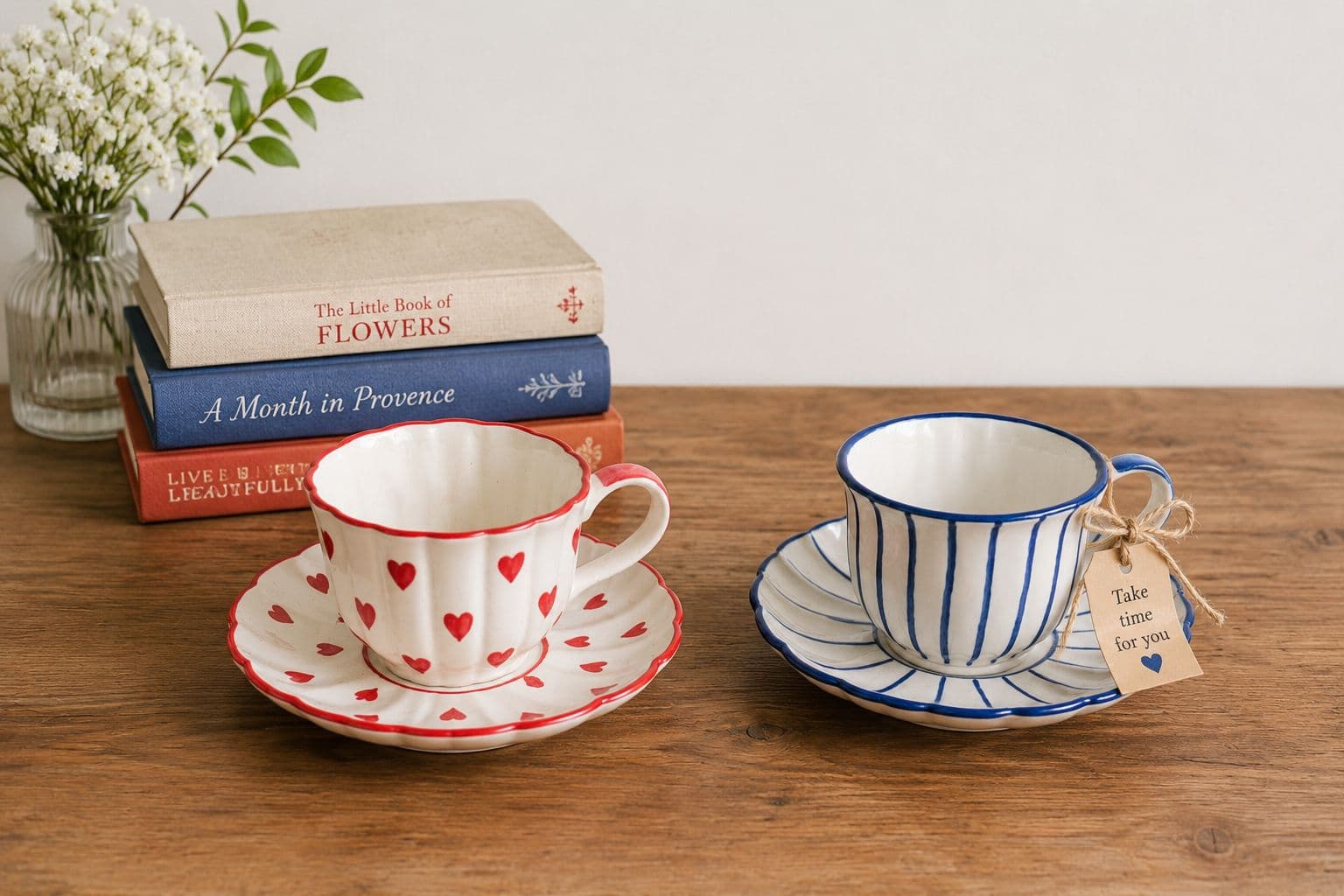
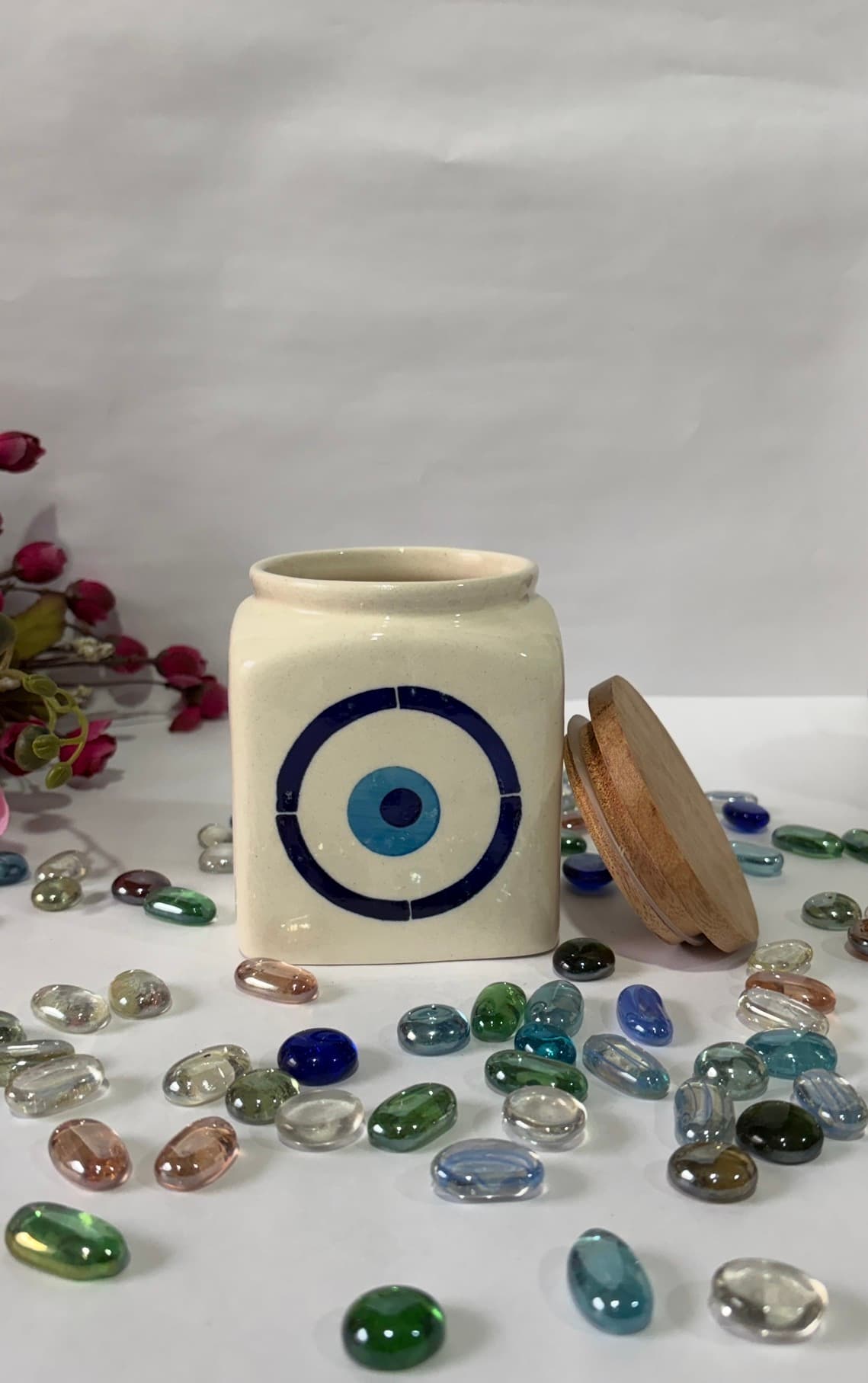
One piece from each of the categories most often shipped together: washed ware for hospitality, a bathroom set, a lidded jar and a vase. Mixed orders across categories are normal.


Common Questions
About importing from India.
Do I need an import licence to buy ceramics from India?
For ordinary ceramic tableware and décor, most countries do not require a licence for the product itself. What you do need is to be registered with your own customs authority as a commercial importer: an EORI number, which is a trader registration number, in the EU and UK, and in the United States a customs bond plus a named importer of record, meaning the business legally responsible for the entry. The Indian side of the licensing, chiefly the Importer Exporter Code, is your supplier’s responsibility and not yours.
Which HS code covers ceramic home décor?
Most of it sits in Chapter 69 of the Harmonised System, the international product-coding system customs authorities use. Heading 6911 covers tableware, kitchenware, other household articles and toilet articles made of porcelain or china. Heading 6912 covers the same kinds of articles made of other ceramic materials, such as stoneware and earthenware. Heading 6913 covers statuettes and other ornamental ceramic articles. The choice between 6911 and 6912 depends on what the ceramic body is made of, and the choice between those and 6913 depends on whether the piece is functional or purely decorative.
Should I use FOB or FCA for a container of ceramics?
FCA, Free Carrier, is usually the better fit. FOB, Free On Board, is one of four Incoterms 2020 rules written for sea shipping, and it passes risk to the buyer only once the goods are on board the ship. Container cargo is handed over to the shipping line at a terminal several days before that, which leaves a gap where the seller no longer has the goods but still carries the risk if they are damaged. FCA closes that gap by passing risk at the point where the goods actually change hands.
Do decorative ceramics need food-contact testing?
Only if they are meant to hold food or drink. A vase, a figurine or a soap dispenser does not, so the food-contact rules do not apply to it. A cup, a saucer or a storage jar for dry goods does. In the EU that means the piece must stay within the lead and cadmium limits set by Directive 84/500/EEC, and must travel with a written declaration of compliance, which is a signed statement from the maker confirming it does. In the United States, ceramic foodware is measured against the FDA action levels for lead and cadmium, the thresholds at which the agency can act against a product.
Who issues an Indian certificate of origin?
Your supplier does, not you. A certificate of origin is an official confirmation of where goods were made, and for Indian exports it is issued electronically through the government eCoO platform at trade.gov.in. Electronic filing became mandatory for ordinary certificates from 1 January 2025 and for preferential ones, used to claim a reduced duty rate under a trade agreement, from 17 January 2025. The application is made against the exporter’s own licence number, so ask them for it rather than trying to obtain one yourself.
Sources and further reading
Where this guide states a rule, these are the instruments behind it. Check the current text before relying on any figure, since limits and rates are revised.
- Incoterms® 2020, International Chamber of Commerce.
- Harmonised System, Chapter 69, and the notes to headings 6911 to 6913.
- FDA Compliance Policy Guide 545.450 (lead in pottery) and 545.400 (cadmium).
- Council Directive 84/500/EEC, as amended by Commission Directive 2005/31/EC, and Regulation (EC) 1935/2004.
- Netherlands Commodities Act amendment for food-contact ceramics, in force 29 May 2026.
- ISPM 15, International Plant Protection Convention.
- 19 U.S.C. § 1304 and 19 CFR Part 134, country of origin marking.
- ISO 2859-1:2026, sampling procedures for inspection by attributes.
- DGFT eCoO platform, trade.gov.in, for Indian certificates of origin.
Related guides: bulk sourcing from India, ceramic materials and safety, and Khurja ceramics explained.
Get in touch
Ready to place an order?
We respond to all enquiries within 24h.